Tuesday, December 09, 2014

For ICN2 to Succeed, We Need a New Food System Paradigm

By: Marc Van Ameringen

Executive Director, Global Alliance for Improved Nutrition

FARMING AFRICA

By 2050, the world's population will reach 9 billion -- and all will need nutritious diets. Yet despite the intrinsic relationship between the food we grow and the food we eat, the agriculture and nutrition sectors are only just now beginning to overcome decades of mutual isolation. The high rates of malnutrition among farming communities are a stark reminder that the link between agriculture and nutrition is not as it should be.

Today, we are starting to see the divide between agriculture and nutrition begin to close. But it's fair to say that our food system is broken. All the time, money and effort spent on trying to make it work still doesn't make the food system deliver everyone an optimal diet. Today, up to 805 million people are hungry and 2 billion are malnourished -- and 70 percent of them live in rural areas, with many rapidly moving to already swollen cities.

At the same time, 1.4 billion are overweight and obese, fuelled by Western-style diets that are damaging the planet and our health. Climate change is increasing food insecurity -- particularly for rural populations which are most vulnerable to erratic weather patterns and unpredictable planting and harvest cycles. And despite many not having enough to eat, globally we throw away a staggering 1.3 billion tons of food each year.

Dietary diversity is among the key components of a healthy diet. In an ideal world everyone would have access to diverse diets, with a mix of fruits, vegetables and whole grains that provide the nutrients we need to live productive, healthy lives. That ideal, however, is still some way off.

Across the entire agricultural value chain there are opportunities to make food more nutritious at each stage. From seed choices and growing techniques to processing food and bringing products to market, innovations and individuals are making the food system work better. We are building the evidence base to better understand where nutrition is being woven into the agricultural chain, and how we can scale up these innovations.

But questions remain. How can we deliver better, more nutritious seed? Is there a better way of measuring impact? What do we need to do to enact the right policies to sustainably support agriculture and nutrition and keep this dialogue moving? With world leaders coming together at the second International Conference on Nutrition in Rome next week, we have a historic opportunity to advance the policies the nutrition community knows can work and to make our food system more responsive to human needs.

The food system won't self-correct. We need more ambition, more innovation and more leadership to create a food system that delivers affordable, healthy diets to everyone in the world. For the Global Alliance for Improved Nutrition, that amounts to a food system that generates demand for nutritious food across the value chain; increases agricultural yields as well as the nutritional quality of foods; and acts as an incubator for innovative ideas, while recognizing the importance of proven interventions that improve the nutritional value of food such as large-scale food fortification.

We need to support sustainable solutions, and open a dialogue on what an optimal diet looks like. We must encourage the development of a global food system that leapfrogs bad diets so that we solve malnutrition without inadvertently exporting an obesity crisis. In Africa, the huge investment in cellphone technology has put a mobile phone in every household, leapfrogging landlines. We need to ask whether it is possible to do the same for a nutritious food system.

It's only by coming together to focus on the obstacles and opportunities that we will succeed in building a better food system. Conflict, humanitarian crises and climate change will take their toll on the most malnourished and exacerbate nutrition and food security challenges over the long term.

The Second International Conference on Nutrition (ICN2) is a critical opportunity to develop a sustainable food system that delivers healthy, nutritious, affordable food to those that need it most. If we are to become the generation that ends malnutrition nothing short of a new food system paradigm will do.

Wednesday, November 26, 2014

Predict Your Own Thanksgiving-Snowstorm Travel Misery

By: JOHN METCALFE and originally published here
The National Weather Service has an experimental new tool that shows the weather hazards along your journey, including predicted snow accumulations.
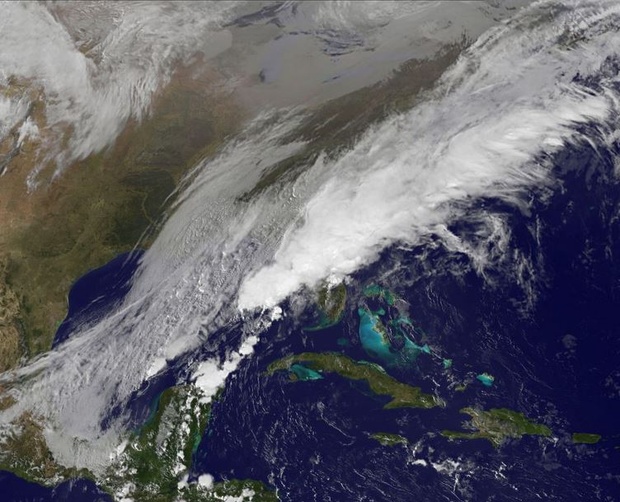
Foul winter weather is moving over the East Coast. (NASA/GOES)
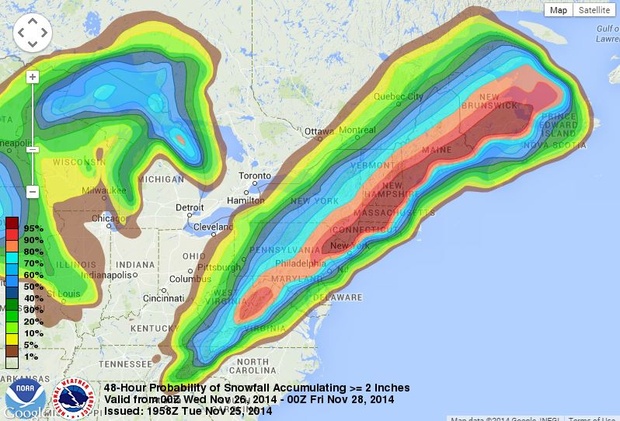
A swollen storm with lousy timing is lurching toward the U.S. East Coast this Thanksgiving, and the implications for travel are worrying. With 1 to 3 inches of snow predicted for the I-95 corridor by Wednesday night (and up to 6 inches farther west), it's easy to gnaw fingernails over a possible commuter ant-crawl, littered with stalls, wrecks, airline delays, rage, and all the other fun ingredients of a mass-migration kerfuffle.

The National Weather Service office in Philadelphia says to "expect flight delays" and trouble on the roads, and is advising people finish their journeys "before 7 AM Wednesday morning." (Meaning if you haven't left yet, better get cracking now). "Conditions will be quickly deteriorating Wednesday evening,"adds the agency's bureau in Gray, Maine. "We anticipate travel will be very difficult around that time." New York cuts right to the point with this: "THE SNOWFALL WILL SIGNIFICANTLY IMPACT HOLIDAY TRAVEL... MAKING DRIVING DANGEROUS AT TIMES."
Here's a forecast of accumulations from the NWS Weather Prediction Center, with pink-and-red the areas having a high probability of getting two-or-more inches of snow from this storm:

NWS
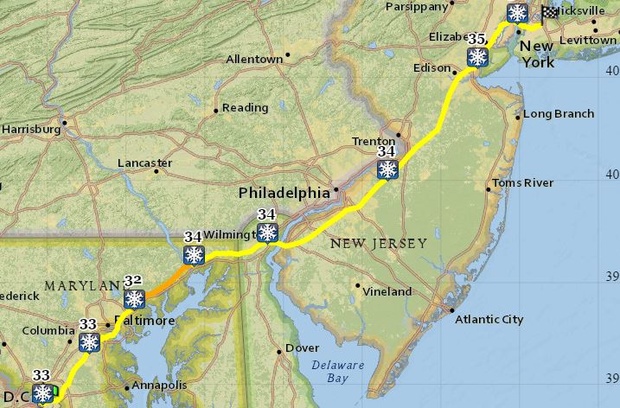
How could this nasty weather affect your holiday commute? To answer that question, you might want to check out an experimental travel tool the NWS isnow promoting. The "Enhanced Data Display v4.3.2" allows you to plot a road trip from Point A to B while giving the expected conditions at intervals along the way. For instance, here's the route a driver might take to New York departing from D.C. at 2 p.m. Wednesday:

Hover the mouse over the weather icons inside the tool itself and a window pops up with worst case-scenario forecasts and warnings. By the time the motorist gets to Baltimore, there could be 2 inches of snow on the ground, wind gusts nearing 20 mph, and a visibility of 2 miles. Arriving on New York's doorstep in Union City, New Jersey, the motorist might find conditions have worsened to 3.3 inches of snow, 29 mph gusts, and a Winter Weather Advisoryin effect.

Being a prototype, the tool isn't perfect: Its "forecast valid" data are, for now, shown in Coordinated Universal Time (though the weather predictions are displayed correctly in local time). And its estimations of arrival times are wildly optimistic for a snow day—there's no way in icy hell that drivers will get from D.C. to New York in under four hours Wednesday afternoon. Still, as a means to glimpse the suffering this storm could sow across the region, it makes a pretty nifty crystal ball.

Monday, August 25, 2014

The Death of the American South

August 19, 2014 from http://sustainableatlantaga.com/

Great Smoky Mountains gettysburg.edu
Great Smoky Mountains
gettysburg.edu
Over the next 45 years rapid urban sprawl will dramatically affect the American Southeast, possibly altering the very essence of what the South represents both socially and environmentally. The South, for many years now, has served as a refuge from the blunt, fast-paced Northeast, offering all the charms of the city at a much more leisurely pace. Instead of a house next to an abandoned factory in Rhode Island, the South offered a house under the canopy of some of the most diverse forests in the world. Unfortunately, the South is about to become a victim of its own success.

The massive urban sprawl predicted for the Southeast could eviscerate that leisurely lifestyle, that southern hospitality, and that beautiful forestry that has come to define the region. The entire area stretching from Atlanta to Raleigh will likely become one huge paved suburb, unrecognizable from any other generic suburb within the next 40 to 50 years. The South is well on its way to recreated the entire Northeast megalopolis that stretches from DC to Boston, except with even more inefficient land use patterns. This will likely create pollution, traffic, and stress much worse than what people were escaping when they first came to the South.


Urbanization 2009 (top) vs. Projected Urbanization 2060 (bottom) A, Terando, plosone.org
A joint study between the US Geological Survey and North Carolina State University released last month shows urban sprawl increasing throughout the Southeast by between 110 and 190 percent by 2060. This sprawl is largely at the expense of agricultural and forested lands as farms and forests make way for cul-de-sacs and tract housing. The area between Atlanta and Raleigh (called the “Piedmont Region” by the authors) will experience the greatest sprawl, changing from about 10 percent urbanized to nearly 30 percent urbanized by 2060. This is followed closely by an area bounded roughly by the middle and northern part of the Florida up through Savannah (the “Florida Coastal Plain”), which will increase from about 15 percent urbanized to nearly 30 percent urbanized by 2060.

This reckless shift of land uses for purely economic purposes will create many negative externalities ranging from the decreased quality of life to the degradation of the environment to higher infrastructure costs (aka taxes). Let’s start with the least controversial, most objective externalities and move to the more debatable one.

Sprawl and infrastructure costs are positively correlated; as sprawl increases, infrastructure costs increase. This makes sense just thinking about it: if people live farther apart then the cost to run pipes, electrical wires, streets, etc to all of them increases. Luckily, we don’t have to think about it because people get paid to do this research. In addition to necessities, the cost to provide adequate fire and police coverage also increases as more stations are needed to allow emergency vehicles to provide reasonable response times.  This additional cost could be directly passed on to the user (you pay fees for the city/county to pave a road to your far-away house, run pipes, wires, etc) or could just be included in taxes and the entire community supports the sprawl. Either way, it’s expensive.
Synchronous Fireflies in Great Smokey Mountains firefly.org
Synchronous Fireflies in Great Smoky Mountains
firefly.org
Another less controversial externality is the destruction of the environment. More roads and houses equals less natural environment. Not only does the road or house actually displace the natural environment, but it then goes and affirmatively harms the environment with runoff from lawns and roads. While this is sad wherever it happens, it’s particularly sad in the Southeast since our forests are some of the most diverse in the world. Ninety-two percent of all bird species in the United States reside in the South. Yes, 92 percent! That goes along with 69 percent of reptiles and 57% of mammals. Recently researchers discovered a group of synchronous fireflies in the Great Smoky Mountains National Park. This is significant because prior to this discovery only one other population of fireflies (in Siam/Thailand) exhibited coordinated flash behaviors. Since then a number of other firefly populations throughout the Southeast have shown this behavior. Perhaps one of the most magically diverse forests in the world is more important than comforting ourselves by making sure we can safely see another Waffle House while sitting inside a Waffle House.

Comfortably Eat Waffles While Gazing at Another WH Within Just 1000 Feet! At GA 53 and GA 400 in Dawsonville.
Quality of life is always controversial because it’s clearly subjective. Unlike the quantifiable costs of running pipes greater distances and ecological destruction, quality of life cannot be easily quantified. Sure we can cite data, but this data is always circumstantial evidence of the happiness of people. Data showing how long people sit in traffic, the rate of heart disease or diabetes, the crime rate, pollution levels, weather, or anything along those lines may suggest that people should feel some way, but it obviously isn’t necessarily an accurate gauge of how people actually feel. It’s important and informational data nonetheless.
SE Cities
After Creating Such a Beautiful City in Savannah, Are We Destined for Generic Sprawl? prettyhouses.savannah.com
While the authors’ note that their predictions do not take into account the various ways in which land could be developed into urbanized areas, the likelihood is that most of the development will be low-density and auto-centric. Typical suburban development, characterized by leafy suburban development where everyone pretty much has one or two roads as their only options for commuting in any way, has already proved to cause more traffic than denser areas and to contribute to less-healthy lifestyles. This includes health issues related unsafe walking conditions, increased chances of being in a car crash, and other issues related to sedentary lifestyles due to auto-reliance. As violence in cities approaches historic lows, the gap between crime in cities and suburbs continues to dramatically narrow, and as motor vehicles continue to be the leading cause of death for those between the ages of 16 and 25, suburban development is quickly losing the safety argument.

More sprawl creates more traffic and more traffic usually creates more stress and more stress usually makes people less happy. While many different researchers have reached many different conclusions on whether or not suburban or urban residents have longer commutes, there’s really no debate over whether building more roads reduces traffic: it doesn’t. The idea of induced demand dictates that as you build more roads, more demand is created and eventually traffic remains stagnant or gets worse. If the Southeast is destined to create auto-centric, low-dense land use patterns then we are destined to continue to run into the induced demand principle. The Southeast will simply follow Atlanta’s lead and run itself into a negative loop of building more roads to solve traffic problems only to find that traffic just gets worse.

In addition to traffic and health problems, sprawled development increases living costs by tipping the housing/transportation balance. While a house in the suburbs may cost less, the costs associated with transportation more than make up for the difference. Residents in the core areas of cities generally have access to cheaper transportation options, including public transit and walking, which lowers their overall cost-of-living compared to suburban residents. The key here is that alternative transportation choices need to be made available.
A City in the Forest http://atlurbanist.tumblr.com/post/59007978743/no-waterfront-or-mountainscape-this-city-has-trees
A City in the Forest
http://atlurbanist.tumblr.com
The laid-back lifestyle, hospitality, and abundant environment has come to define the South. People grow up here proud to know that this is what their region represents. People move here seeking refuge from stressful environments; hoping to discover the many beautiful things those who grew up here already know and love. Our connection to the environment must account for something. Our cities and towns have  grown up as an extension of nature, seamlessly intertwining the built and natural environments into one living unit. Our largest and most cosmopolitan urban environment is the City in the Forest. Nature most certainly created this relationship from the very beginning with its incessant need to strangle any human development, but we’ve grown with it. Perhaps this relationship with nature is the South. Our constant connection to the environment has allowed us to enjoy the simple, important things in life and not stress about the complications of human society.

While in the past we may not have had any choice; nature was going to exert its will and we built our communities based on its demands. Today we could simply pave over it. Eventually it would reclaim the land, but not for many years. This is the choice we face. Our region has grown up in a relationship with nature and that relationship has helped foster the culture and essence of the South. The land has made us who we are. It’s defined the culture of the region for thousands of years. While we want to grow as a region, we want to grow in a smart manner. We need to use our land wisely and not waste it on endless parking lots and cul-de-sacs. The region should grow, but it should take into account smart growth principles such as alternative transportation choices, green spaces, natural spaces, mixed-use, and denser development. Let’s not simply repeat the same mistakes others have made in a way that will destroy almost everything we love about this region.

Tuesday, April 15, 2014

Is Google Glass a Newton for Millennials?

by: William A. Aultman

So today, and today only, the US public can, under the moniker of an "Explorer", go online and buy Google Glass (or is it "a Google Glass", wtfe...) for the not-so-meager price of $1500 plus tax. This effort by Google to create an air of exclusivity and temporal urgency in this "one day only" release seems more like a marketing ploy than a real, beta-type release aimed at making the product better for the masses. 

This brings us to my big question: What does Google Glass really do?

The answer, as best as I can tell, is "Not much my iPhone doesn't do, I just wear it on my face." 

Now we all (this is about to be a very assumptive blanket statement) have dreams of the day when our technology is fully and seamlessly integrated into life and lifestyle. The day when screens and buttons give way to projections and gestures, but I just don't see Google Glass as being the next big thing... quite yet. 

Here's why:

1.)    We want to look cool. Technology has never made someone cool who wasn't a little bit cool to begin with. Period. Frankly, the photos and videos of Sergey and other people wearing Google Glass I have seen makes them look either pompous or disabled, and that is just not going to fly with the "selfie" generation. Well, maybe the pompous thing for a bit, but like their latest "meme" t-shirt, that will not last long.

2.)    Google Glass is over twice the price of the most expensive smartphone and it does not even function as a phone. It will tether to your phone with a Bluetooth connection, but that ultimately makes it just a really, really expensive Bluetooth earpiece and we all gave those up a long time ago. Well, except for the 40-something DB in accounting that still wears Polo Sport cologne and always talks about how he's gonna "give it" to Kim from receiving one of these days. Don't be that guy.

3.)   Things you wear on your face tend to be: easy to lose, fragile and detached from your person fairly quickly. Everyone who has bad eyesight or likes nice sunglasses knows the sheer panic and frustration of broken or, even worse, lost eyewear. It is not a question of "if" it is going to happen, but rather "when". 

Also, if I may indulge, the world is a tough place. There are probably a number of people within a few hundred yards from where you are right now that might have lost a recent sports related bet that was "gonna get em out of the hole", or is a tattooed drug addict with the nickname Mr. Softy, or is a reclusive technophile that combs the internet for free patterns to make that "skin-suit" they have always wanted but, until now, have not had the courage to kidnap and kill for. Well, that last one is a stretch but regardless, for these types of people, bumping into you on a side street while you are preoccupied sending a SMS from your face is a win-win! The point I'm trying to make is that wearable technology attracts attention, good and bad. You might as well tape 15 one-hundred dollar bills to your forehead and stumble around on a self guided tour of the underpass down by the river.

In the end, there are many reasons to want Google Glass, but I really think there are so many more reasons NOT to want Google Glass. Now don't get me wrong... I see the workplace applications with these nifty yet dorky headsets to be infinite and damn well ingenious. The list of possible applications for public transit operators, police and fire personnel, professional musicians, tour guides, public officials, etc. goes on and on but much like the Apple Newton, the ill fated predecessor to the PDA/smart phone device, it is just not the right time or the proper human interface to gain widespread public use. Not that we as technologically aware consumers will not get there, but I think this technology would be more fitting and useful in the not so distant future when we are making our almost-supersonic commute in a hyper-tube to meet with our World Industry clients to take a cruise in their solar-powered airship to survey the new location for their algae-power generation fields. One day soon, right?

Until then... don't be that guy. 

Tuesday, February 11, 2014

An Introduction to Climate Change

by Wissam Yassine
Climate change refers to the current changes in the Earth’s climate patterns due to the increase in greenhouse gases emitted by human activities. The driving force behind this pattern is an increase in the Earth’s surface and water temperature. In fact, over the last 130 years, the global average temperature of the planet rose by 0.8 °C.  However, the impacts of this temperature increase on climate patterns in different regions varied widely (Figure 1).
National scientific bodies in all major countries agree that the cause behind global warming and climate change is the increasing concentration of greenhouse gases in the atmosphere due to human activities such as burning fossil fuels, deforestation, and growing livestock. Climate models have been created to forecast the expected increase in the average global temperatures over the coming years based on current and expected emission levels. These models show that the global average temperatures are expected to rise by up to 6 °C by 2100 if greenhouse gas emissions continue to rise as they have in recent decades.

Figure 1: Global surface temperature change according to NASA’s Goddard Institute for Space Studies data. Source: Dr. Peter Gleick, Forbes Blogs
This increase in global temperature will have far-reaching impacts, including an increase in sea level which will threaten coastal and low lying areas, disruption of precipitation patterns around the world, and an increase in the frequency of extreme weather events and heat waves. These impacts will lead to further downstream consequences including species extinction, loss of ecosystems, and the loss of small island states.
This article will shed some light on the science behind climate change and its expected impacts. The article will also highlight global and local action taken to mitigate climate change. Future features in the Road to Doha project will focus on climate change in the context of the Middle East and North Africa, and will detail the specific impacts on the region, its role is mitigating climate change, and adaptation opportunities.
The science of Climate Change
Following years of research, the entire body of climate scientists is almost in complete agreement that global climate change is happening, that it is caused by the increase concentration of greenhouse gases in the atmosphere, and that human induced (or anthropogenic) emissions are the largest contributor to this phenomenon.
Greenhouse gases (GHGs) are a group of gases that are characterized by their ability to trap radiation as it attempts to leave the earth’s atmosphere. The main GHGs in the Earth’s atmosphere are water vapor, carbon dioxide, methane, nitrous oxide, and ozone. Normally, these gases play a positive role in regulating the surface temperature of the planet and making it livable. It is estimated that without these gases our earth would, on average, be 33 °C cooler (Figure 2). However, the increased concentration of these gases caused mainly by burning of fossil fuels is amplifying the natural warming effect and leading to an observed increase in global temperature.

Figure 2: The Greenhouse effect by the National Academy of Science. Source: the Pew Center on Global Climate Change
Greenhouse gases vary in their capacity to absorb energy in the atmosphere, also known as their global warming potential (GWP). While one molecule of carbon dioxide (CO2), the predominant of all GHGs, has a global warming potential of 1 GWP, other gases have a much higher global warming potential.  A molecule of methane, example, has a GWP of 72 over 20 years, while a molecule of nitrous oxide has a GWP of 289 over the same period. Yet given the enormous quantities of carbon dioxide emitted into the atmosphere, its overall warming contribution is far greater than any other GHG. As a result, most estimates of GHGs are aggregated and expressed as carbon dioxide equivalents (CO2e ) to ease comparisons and put numbers in perspective. It is estimated that the concentration of carbon dioxide equivalents in the atmosphere have increased from their pre-industrial average of 280 particles per million (ppm) to more than 390 ppm today.
Based on this historic trend and on climate models, scientists have confirmed that the extent of future increases in earth’s surface temperature would be dependent on the rate of human-induced emissions, which, in turn, is dependent on the size of the global population and its carbon footprint. The most comprehensive forecast of climate change and global warming to date is the 2007 Fourth Assessment Report by the UN Intergovernmental Panel on Climate Change (IPCC). The IPCC models, based on various emissions scenarios and feedback mechanisms,  predicts that in the lowest emissions scenario for 2100 (Scenario B1 in Figure 3) the global surface temperatures will rise between 1.1 to 2.9 °C (2 to 5.2 °F) This scenario assumes  “a convergent world with the same global population as in the A1 storyline but with rapid changes in economic structures toward a service and information economy, with reductions in materials intensity, and the introduction of clean and resource-efficient technologies.”

Figure 3. Surface temperature increase scenarios. Source: IPCC Fourth Assessment Report: Climate Change 2007 , Chapter 10, Figure 10.26
The IPCC models also predict an increase of global surface temperature between 2.4 and 6.4 °C (4.3 to 11.5 °F) for the highest emissions scenario (Scenario A1F1 in Figure 3) which assumes “a very rapid economic growth, low population growth and rapid introduction of new and more efficient technology. Major underlying themes are economic and cultural convergence and capacity building, with a substantial reduction in regional differences in per capita income. In this world, people pursue personal wealth rather than environmental quality.”
With both the worst case and the best case scenarios forecasting a temperature increase, scientists have confirmed that some form of climate change is inevitable. They argued, however, that we need to limit the increase in global surface temperature to 2°C to avoid the worst of climate change. To ensure this, the world needs to collectively halve its 1990 emissions levels by the year 2050. This target appears hard to achieve given that total GHGs emissions have continued to increase since 1990. In fact GHGs emissions have increased in 2010 by a record amount that they surpassed even the worst case scenario of the IPCC report. This trend is currently not showing any signs of a slowdown, let alone reversal. In addition, the cumulative impact of current national pledges to cut carbon emissions fall short of stopping an increase in GHG emissions by 2050, let alone cutting it by any factor (Figure 4).

Figure 4: GHG emissions scenarios. Source: Climate Action Tracker
Furthermore, while climate change is a global challenge that requires a global response, total GHG emissions are not produced uniformly around the world, with 85% of emissions produced by the 20 largest emitting countries. This disparity in responsibility has inevitably led to friction between nations that are most responsible for climate change and those which are most affected by its impacts.
To complicate things further, nations also vary greatly in their per capita emissions. China, for example, is the world’s largest emitter in absolute terms since it overtook the United States in 2006. However, on a per capita basis, China ranks much lower than the US which has one of the highest per capita emissions rates. In the Middle East, this variation is also evident. Qatar for example leads the region -and the world- with 53.47 tons of CO2e per capita per year compared to a world’s average per capita emissions of just above 5 tons. Morocco on the other hand emits a mere 1.5 tons CO2e per capita in the same period.  Halving the world’s GHG emissions requires achieving a world average per capita carbon footprint of approximately 2 tons CO2e.
Impacts of Climate Change
For one to develop a strategy for adapting to climate change, it’s important to understand the complex and intertwining impacts of global warming.
It is estimated that increases in sea temperature will cause thermal expansion of the world’s oceans and seas. This expansion, coupled with melted land-based ice, will lead to a rise in sea levels. It is estimated that sea levels have already risen by 0.17 meters over the last century and are expected to rise further by 0.18 to 0.59 meters by the year 2100. A sea level rise of such magnitude is expected to put many cities and islands under water and to displace millions around the world.
Climate change is also expected to contribute to an increased frequency and intensity of extreme weather events such as hurricanes, flood, droughts and heavy participation events. Many of these events are already being observed around the world. Events such as the heat waves in Russia, extreme cooling in Europe, hurricanes in the US, floods in Pakistan, and draught in the African horn have been linked to the impacts of climate change.
Climate change is also expected to lead to adverse ecological and socio-economic impacts such as reduced agricultural production and food security, risks to human health, and reduced biodiversity. Changes to participation patterns will lead to severe water shortage in some areas and heavy floods in others. Rising temperatures will also increase the risk of diseases such as malaria as more areas become prone to such diseases.
It must be said that the exact extent of these impacts cannot be accurately forecasted and will eventually depend on the actual level of warming, the interactions between the various climate systems, and the responsiveness of ecosystems to such relatively fast climate changes (Figure 5). Yet, even the currently observed impacts are serious enough to warrant a global action to mitigate climate change and avoid irreversible large scale disruptions to the Earth’s natural systems.

Figure 5: Interconnection of climate system, human activities, and climate change impacts. Source: United Nations Environmental Program
The politics of Climate Change
International efforts to mitigate climate change started at the Earth Summit in Rio de Janeiro in 1992. The Earth Summit resulted in the signing of the United Nations Framework Convention on Climate Change (UNFCCC), which now has 195 parties. The objective of the UNFCCC is to “stabilize greenhouse gas concentrations in the atmosphere at a level that would prevent dangerous anthropogenic interference with the climate system.”
Since then, major breakthroughs in climate negotiations took place and major commitments were made, the most significant of which is the Kyoto protocol which was negotiated in 1997 and entered into force in 2005 (figure 6). Recognizing the wide difference in historical GHG emissions across countries, parties to the Kyoto protocol agreed that they had “common but differentiated responsibilities” towards reducing their GHG emissions.  In that spirit, developed countries agreed to reduce their emissions by an average of 5.2% below 1990 levels by 2008-2012, the first commitment period under the Kyoto protocol.

Figure 6: Timeline showing major milestones in international climate change negotiations. Source: the Pew Center on Global Climate Change
The Kyoto protocol was a major step forward; however, the 37 developed countries with binding reduction targets under the Kyoto protocol represented only 25% of the world’s global emissions. It was clear that the world needed a new treaty that included developing countries such China, India, and Brazil, whose shares of global emissions grew significantly since the Kyoto Protocol was negotiated, as well as major players such as the United States which was not party to the Kyoto Protocol.
In 2005, parties to the Kyoto protocol together with the United States agreed in Montreal to start negotiating a post-2012 emissions reduction commitment with the aim of reaching an agreement in Copenhagen in 2009. However, the outcome of Copenhagen was a true disappointment as the United States succeeded in steering the negotiations away from a legally binding emissions reduction commitment. The alternative was the Copenhagen Accord, which calls on developed countries to commit to “economy-wide emissions targets for 2020”. The targets were discretionary and non-binding, which is why the 15th Conference of Parties (COP 15) in Copenhagen was largely seen as a step backwards in climate negotiations.
However, the notion of a binding emissions reduction treaty that covers all countries – developed and developing – was revived two years later in Durban’s COP 17. The 2011 conference ended a very intense and politically polarized round of negotiations with countries agreeing on reaching a legally binding agreement by 2015 which would take effect after 2020. The outcome of Durban’s COP 17 places great expectations on COP 18 in Doha which will host the first round of negotiations dedicated toward reaching the 2015 agreement.
With such high hopes for event, it is our hope that the Road to Doha project by Carboun would help highlight the significance of hosting these negotiations in the region, in addition to helping build awareness of climate change impacts on the Middle East and the challenges they pose for the region.
Wissam Yassine is a Senior Sustainability Engineer based in Dubai and a Masters in Sustainability candidate at Harvard University Extension School. He can be contacted at Wissam [at] Carboun [dot] com

Wednesday, December 18, 2013

Forget Golf Courses: Subdivisions Draw Residents With Farms

Paige Witherington is the farmer at Serenbe Farms, a 30-acre certified organic and biodynamic farm adjacent to a housing development outside Atlanta. It's one of more than 200 or so subdivisions with an agricultural twist nationwide. Courtesy of Serenbe

When you picture a housing development in the suburbs, you might imagine golf courses, swimming pools, rows of identical houses.

But now, there's a new model springing up across the country that taps into the local food movement: Farms — complete with livestock, vegetables and fruit trees — are serving as the latest suburban amenity.

It's called development-supported agriculture, a more intimate version of community-supported agriculture — a farm-share program commonly known as CSA. In planning a new neighborhood, a developer includes some form of food production — a farm, community garden, orchard, livestock operation, edible park — that is meant to draw in new buyers, increase values and stitch neighbors together.

"These projects are becoming more and more mainstream," says Ed McMahon, a fellow with the Urban Land Institute. He estimates that more than 200 developments with an agricultural twist already exist nationwide.

"Golf courses cost millions to build and maintain, and we're kind of overbuilt on golf courses already," he says. "If you put in a farm where we can grow things and make money from the farm, it becomes an even better deal."

In Fort Collins, Colo., developers are currently constructing one of the country's newest development-supported farms. At first blush, the Bucking Horse development looks like your average halfway-constructed subdivision. But look a bit closer and you'll see a historic rustic red farm house and a big white barn enclosed by the plastic orange construction fencing.

The Bucking Horse subdivision in Fort Collins, Colo., will include a working CSA farm, complete with historic barn, farm house and chicken coop.i
The Bucking Horse subdivision in Fort Collins, Colo., will include a working CSA farm, complete with historic barn, farm house and chicken coop.


"When we show it, people are either like, 'You guys are crazy. I don't see the vision here at all,' or they come and they're like, 'This is going to be amazing,' " says Kristin Kirkpatrick, who works for Bellisimo Inc., the developer that purchased the 240-acre plot of land.

The Bucking Horse subdivision in Fort Collins, Colo., will include a working CSA farm, complete with historic barn, farm house and chicken coop. Luke Runyon/Harvest Public Media

When finished, Bucking Horse will support more than 1,000 households. Agriculture and food production are the big draws, Kirkpatrick says. Land has been set aside for vegetables. There will be goats and chickens, too, subsidized by homeowners. Soon they'll be hiring a farmer for a 3.6-acre CSA farm. There's also a plaza designed for a farmers market, and an educational center where homeowners can take canning classes.

In short, the neighborhood plan is infused with the quaint, pastoral, even romantic view of farming.

"Our public restrooms are in an old chicken coop, and it'll be half public restroom and half chicken coop," Kirkpatrick says.
After World War II, Americans escaping crowded cities flocked to the suburbs. Most suburbanites didn't want to be right next to a farm, and so restrictive zoning pushed livestock and tractors out of new residential areas. Now, says Lindsay Ex, an environmental planner with the city of Fort Collins, municipalities are being forced to change their codes.

"We used to have residential separated from agriculture, and now we're seeing those uses combined," says Ex.

And that can be a great deal for small-time farmers, says Quint Redmond, who runs a company called Agriburbia, which operates farms within suburban developments across the country. In development-supported agriculture projects, he says, the developer, or homeowners association, ends up making the big farm purchases — not the farmer.

"The best possible thing for a farmer is to have the infrastructure ready," he says. "That is where most farming goes upside down or goes broke."

Not to mention that the neighborhood is filled with people who already have an interest in local food, so "there's a real market for that farmer," Redmond says.

The marketing of these new neighborhoods appears to be working — at least at Bucking Horse, where the developer says 200 single-family lots were snatched up within days of going on the market. Values of existing homes have jumped 25 percent since construction began on the agricultural amenities.

"Once we saw this and the plans they had for it, we were really sold on the lifestyle," says Lindley Greene, who moved to Bucking Horse in March with her husband and two young sons.

Once the neighborhood farm is up and running, Greene says, she'll be volunteering to get her hands dirty.

"We love the idea of it," she says. "To have it right here — not have it in our backyard, but still in our backyard — is awesome."

This story comes to us via Harvest Public Media, a public radio reporting collaboration that focuses on agriculture and food production. by Luke Runyon

Tuesday, December 17, 2013

Alternative Fuel Vehicles to Gain Traction Over the Next 10 Years

​NACS Press Release | November 19, 2013

ALEXANDRIA, VA – The growth of vehicles running on alternative fuels will accelerate over the next decade, but diesel fuel- and gasoline-powered vehicles will continue to dominate market share, according to “Tomorrow’s Vehicles: What Will We Drive in 2023?” a new report released today by the Fuels Institute.
For light-duty vehicles (passenger vehicles and light trucks), gasoline-powered vehicles will continue to dominate the market, although overall market share could decline from 93% in 2012 to as low as 82% of vehicle inventories in 2023. Diesel-powered vehicles will potentially comprise nearly 7% of the market while flexible-fuel vehicles capable of using E85 could grow to more than 9% of the market.
Meanwhile, for medium- and heavy-duty vehicles (commercial vehicles like trucks and buses), diesel-powered vehicles will prevail, representing at least 94% of the vehicle fleet in 2023.
“On the surface, it may not seem that significant change is occurring, because gasoline and diesel fuel-powered vehicles will continue to dominate the vehicle fleet in 2023, but alternatives are gaining traction,” said John Eichberger, executive director of the Fuels Institute. “Consumers appear to be more open to alternatives than ever before and vehicle manufacturers are offering a wider variety.”
Given that there are more than 250 million vehicles on the road today, it will take years of strong sales of alternative fuel vehicles to reshape the country’s vehicle fleet. In addition, a variety of developments — including cost reductions for alternative-fuel vehicles, conveniently available refueling options, expanded vehicle range and overall consumer familiarity and confidence with new fueling options — will need to occur before alternative-fueled vehicles can capture significant market share.
“We need to ask — and answer — some tough questions so that the vehicles and fueling markets can develop together and convert consumers to new type of vehicles, said Eichberger.”
The Fuels Institute, founded by the National Association of Convenience Stores (NACS), is a non-profit, research-oriented think-tank dedicated to evaluating the market issues related to consumer vehicles and the fuels that power them. It commissioned Navigant Research to provide a forecast of the vehicles market through 2023 that captures approximately two generations of vehicle development, providing a reliable look into the future but not reaching so far into the future as to be rendered unreliable.

Gasoline Will Dominate the LDV Market

The report forecast the makeup of the vehicle fleet in 2023 based on two scenarios: a “base case” that incorporates current forecasts and an “aggressive case” that assumes more robust world economic conditions that further spurs demand and prices for petroleum products.
In both projections, gasoline-powered vehicles will continue to dominate the LDV market but lose significant market share, dropping from 93.2% of LDVs on the road in 2012 to between 82.6% to 86.0% in 2023. This decline in market share is driven by a shift in the sale of new vehicles, with gasoline-powered vehicles’ share of sales falling from 83.4% in 2012 to between 67.6% to 78.9% in 2023, a potentially dramatic change in consumer purchasing behavior.

Diesel Fuel Will Gain LDV Share and Maintain Medium and Heavy-Duty Share

Diesel-powered vehicles are expected to see strong growth in the LDV market, growing from 2.0% of all LDVs in 2012 to between 3.7% to 6.7% of the LDV fleet in 2023. This surge in market share will be led by the sales of new vehicles hitting the market. Diesel-powered LDV sales are expected to comprise between 7.2% to 17.8% of new LDV sales in 2023.
With respect to medium- and heavy-duty vehicles (M/HDV), diesel fuel will see a slight decline, with its market share dipping from a near-ubiquitous 99.4% in 2012 to between 94.6% to 97.5% in 2023. The primary competition to diesel fuel in the M/HDV market will be natural gas.

Even With Dramatic Sales Increases, Others Will Lag Behind

Despite increased attention from policymakers and public-opinion leaders, there are many hurdles to overcome before a robust market emerges for other types of vehicles. But some growth in the next ten years is projected:
  • Flexible-fuel vehicles: Flexible-fuel vehicles (FFV), which can use both gasoline or E85, show the most promise for growth. In 2012, only 4.7% of LDVs were flexible-fuel vehicles; however, automaker production is forecast to double FFV’s share of the market to 9.3% of the fleet by 2023. However, the potential for this alternative fuel is tempered by lackluster existing demand and limited availability of E85.
  • Natural gas vehicles: The number of light-duty natural gas-powered vehicles (NGV) is expected to see at least a ten-fold increase over the next decade, but will still only represent 0.43% in the aggressive case. However, in the M/HDV market, compressed natural gas is projected to capture up to 3.8% of the market in the aggressive case. The high cost of installing natural gas facilities at retail and the cost of vehicle conversion or production will be factors limiting additional growth by 2023.
  • Propane-vehicles: Propane-powered LDVs are expected to double market share, but will grow from only 0.04% to 0.07% of all LDVs by 2023. For M/HDVs, propane is currently the second-most-popular option after diesel fuel, capturing 0.38% of the market in 2012. However, its growth is considered limited to mainly medium-duty vehicles and will account for no more than 0.76% of the M/HDV fleet in 2023.
  • Battery-electric vehicles: Unless there are significant breakthroughs in battery-charging technology, battery-electric vehicles (BEVs) will not break out of the niche category of LDVs over the next decade. Even with a projected 22- to 26-fold increase in annual sales over the next decade, BEVs are forecast to be no more than 0.72% of the LDV market in 2023.
  • Fuel cells: Fuel-cell vehicles (FCVs), electric vehicles that use an external fuel source like hydrogen, are also expected to remain a niche category. Sales are expected to increase significantly over the coming decade, but the reality is that there were only 500 FCVs on the road in 2012. Even in the most aggressive forecast, registrations are only expected to reach 70,000 vehicles — 0.02% of the LDV market — in 2023.
“Without coordination between the vehicle and fueling industries, successful market introduction of these systems will be characterized by starts and stops, booms and busts and a protracted — and potentially painful — market development phase that may or may not result in consumer acceptance,” said Eichberger. “Consumers have more vehicle options than ever and where they choose to invest their money will determine the future.”
The Fuels Institute’s governing structure incorporates a diverse set of stakeholders including, but not limited to, fuels retailers, fuels producers and refiners, alternative and renewable fuels producers, automobile manufacturers, environmental advocates and consumer organizations. It will continue to commission and publish comprehensive, fact-based research projects that address the issues identified by the affected stakeholders. These projects will help to inform both business owners considering long-term investment decisions and policymakers considering legislation and regulations affecting the market.
###
Founded in 1961 as the National Association of Convenience Stores, NACS is the international association for convenience and fuel retailing. The U.S. convenience store industry, with more than 149,000 stores across the country, posted $700 billion in total sales in 2012 and sells more than 80% of the motor fuels purchased in the United States. NACS has 2,100 retail and 1,600 supplier member companies, which do business in nearly 50 countries.

Thursday, December 05, 2013

"The Lorax" by Dr. Seuss


By: Dr. Seuss

At the far end of town
where the Grickle-grass grows
and the wind smells slow-and-sour when it blows
and no birds ever sing excepting old crows...
is the Street of the Lifted Lorax.

And deep in the Grickle-grass, some people say,
if you look deep enough you can still see, today,
where the Lorax once stood
just as long as it could
before somebody lifted the Lorax away.

What was the Lorax?
Any why was it there?
And why was it lifted and taken somewhere
from the far end of town where the Grickle-grass grows?
The old Once-ler still lives here.
Ask him. He knows.

You won't see the Once-ler.
Don't knock at his door.
He stays in his Lerkim on top of his store.
He stays in his Lerkim, cold under the roor,
where he makes his own clothes
out of miff-muffered moof.
And on special dank midnights in August,
he peeks out of the shutters
and sometimes he speaks
and tells how the Lorax was lifted away.
He'll tell you, perhaps...
if you're willing to pay.

On the end of a rope
he lets down a tin pail
and you have to toss in fifteen cents
and a nail
and the shell of a great-great-great-
grandfather snail.

Then he pulls up the pail,
makes a most careful count
to see if you've paid him
the proper amount.

Then he hides what you paid him
away in his Snuvv,
his secret strange hole
in his gruvvulous glove.
Then he grunts, I will call you by Whisper-ma-Phone,
for the secrets I tell you are for your ears alone.

SLUPP
Down slupps the Whisper-ma-Phone to your ear
and the old Once-ler's whispers are not very clear,
since they have to come down
through a snergelly hose,
and he sounds as if he had
smallish bees up his nose.
Now I'll tell you, he says, with his teeth sounding gray,
how the Lorax got lifted and taken away...
It all started way back...
such a long, long time back...

Way back in the days when the grass was still green
and the pond was still wet
and the clouds were still clean,
and the song of the Swomee-Swans rang out in space...
one morning, I came to this glorious place.
And I first saw the trees!
The Truffula Trees!
The bright-colored tufts of the Truffula Trees!
Mile after mile in the fresh morning breeze.

And under the trees, I saw Brown Bar-ba-loots
frisking about in their Bar-ba-loot suits
as they played in the shade and ate Truffula Fruits.

From the rippulous pond
came the comfortable sound
of the Humming-Fish humming
while splashing around.

But those trees! Those trees!
Those Truffula Trees!
All my life I'd been searching
for trees such as these.
The touch of their tufts
was much softer than silk.
And they had the sweet smell
of fresh butterfly milk.

I felt a great leaping
of joy in my heart.
I knew just what I'd do!
I unloaded my cart.

In no time at all, I had built a small shop.
Then I chopped down a Truffula Tree with one chop.
And with great skillful skill and with great speedy speed,
I took the soft tuft. And I knitted a Thneed!

The instand I'd finished, I heard a ga-Zump!
I looked.
I saw something pop out of the stump
of the tree I'd chopped down. It was sort of a man.
Describe him?...That's hard. I don't know if I can.

He was shortish. And oldish.
And brownish. And mossy.
And he spoke with a voice
that was sharpish and bossy.

Mister! he said with a sawdusty sneeze,
I am the Lorax. I speak for the trees.
I speak for the trees, for the trees have no tongues.
And I'm asking you, sir, at the top of my lungs--
he was very upset as he shouted and puffed--
What's that THING you've made out of my Truffula tuft?

Look, Lorax, I said. There's no cause for alarm.
I chopped just one tree. I am doing no harm.
I'm being quite useful. This thing is a Thneed.
A Thneed's a Fine-Something-That-All-People-Need!
It's a shirt. It's a sock. It's a glove. It's a hat.
But it has other uses. Yes, far beyond that.
You can use it for carpets. For pillows! For sheets!
Or curtains! Or covers for bicycle seats!
The Lorax said,
Sir! You are crazy with greed.
There is no one on earth
who would buy that fool Thneed!

But the very next minute I proved he was wrong.
For, just at that minute, a chap came along,
and he thought that the Thneed I had knitted was great.
He happily bought it for three ninety-eight.
I laughed at the Lorax, You poor stupid guy!
You never can tell what some people will buy.

I repeat, cried the Lorax,
I speak for the trees!

I'm busy, I told him.
Shut up, if you please.
I rushed 'cross the room, and in no time at all,
built a radio-phone. I put in a quick call.
I called all my brothers and uncles and aunts
and I said, Listen here! Here's a wonderful chance
for the whole Once-ler Family to get mighty rich!
Get over here fast! Take the road to North Nitch.
Turn left at Weehawken. Sharp right at South Stich.

And, in no time at all,
in the factory I built,
the whole Once-ler Family
was working full tilt.
We were all knitting Thneeds
just as busy as bees,
to the sound of the chopping
of Truffula Trees.

Then...
Oh! Baby! Oh!
How my business did grow!
Now, chopping one tree
at a time was too slow.

So I quickly invented my Super-Axe-Hacker
which whacked off four Truffula Trees at one smacker.
We were making Thneeds
four times as fast as before!
And that Lorax?... He didn't show up any more.

But the next week
he knocked on my new office door.
He snapped, I'm the Lorax who speaks for the trees
which you seem to be chopping as fast as you please.
But I'm also in charge of the Brown Bar-ba-loots
who played in the shade in their Bar-ba-loot suits
and happily lived, eating Truffula Fruits.
NOW...thanks to your hacking my trees to the ground,
there's not enough Truffula Fruit to go 'round.
And my poor Bar-ba-loots are all getting the crummies
because they have gas, and no food, in their tummies!

They loved living here. But I can't let them stay.
They'll have to find food. And I hope that they may.
Good luck, boys, he cried. And he sent them away.

I, the Once-ler, felt sad
as I watched them all go.
BUT...
business is business!
And business must grow
regardless of crummies in tummies, you know.

I meant no harm. I most truly did not.
But I had to grow bigger. So bigger I got.
I biggered my factory. I biggered my roads.
I biggered my wagons. I biggered the loads
of the Thneeds I shipped out. I was shipping them forth
to the South! To the East! To the West! To the North!
I went right on biggering...selling more Thneeds.
And I biggered my money, which everyone needs.

Then again he came back! I was fixing some pipes
when that old nuisance Lorax came back with more gripes.
I am the Lorax, he coughed and he whiffed.
He sneezed and he snuffled. He snarggled. He sniffed.
Once-ler! he cried with a cruffulous croak.
Once-ler! You're making such smogulous smoke!
My poor Swomee-Swans...why, they can't sing a note!
No one can sing who has smog in his throat.

And so, said the Lorax,
--please pardon my cough--
they cannot live here.
So I'm sending them off.

Where will they go?...
I don't hopefully know.
They may have to fly for a month...or a year...
To escape from the smog you've smogged-up around here.

What's more, snapped the Lorax. (His dander was up.)
Let me say a few words about Gluppity-Glupp.
Your machinery chugs on, day and night without stop
making Gluppity-Glup. Also Schloppity-Schlopp.
And what do you do with this leftover goo?...
I'll show you. You dirty old Once-ler man, you!

You're glumping the pond where the Humming-Fish hummed!
No more can they hum, for their gills are all gummed.
So I'm sending them off. Oh, their future is dreary.
They'll walk on their fins and get woefully weary
in search of some water that isn't so smeary.

And then I got mad.
I got terribly mad.
I yelled at the Lorax, Now listen here, Dad!
All you do is yap-yap and say, Bad! Bad! Bad! Bad!
Well, I have my rights, sir, and I'm telling you
I intend to go on doing just what I do!
And, for your information, you Lorax, I'm figgering
on biggering
and Biggering
and BIGGERING
and BIGGERING!!
turning MORE Truffula Trees into Thneeds
which everyone, EVERYONE, EVERYONE needs!

And at that very moment, we heard a loud whack!
From outside in the fields came a sickening smack
of an axe on a tree. Then we heard the tree fall.
The very last Truffula Tree of them all!

No more trees. No more Thneeds. No more work to be done.
So, in no time, my uncles and aunts, every one,
all waved my good-bye. They jumped into my cars
and drove away under the smoke-smuggered stars.

Now all that was left 'neath the bad-smelling sky
was my big empty factory...
the Lorax...
and I.

The Lorax said nothing. Just gave me a glance...
just gave me a very sad, sad backward glance...
as he lifted himself by the seat of his pants.
And I'll never forget the grim look on his face
when he hoisted himself and took leave of this place,
through a hole in the smog, without leaving a trace.

And all that the Lorax left here in this mess
was a small pile of rocks, with one word...
UNLESS.
Whatever that meant, well, I just couldn't guess.

That was long, long ago.
But each day since that day
I've sat here and worried
and worried away.
Through the years, while my buildings
have fallen apart,
I've worried about it
with all of my heart.

But now, says the Once-ler,
Now that you're here,
the word of the Lorax seems perfectly clear.
UNLESS someone like you
cares a whole awful lot,
nothing is going to get better.
It's not.

SO...
Catch! calls the Once-ler.
He lets something fall.
It's a Truffula Seed.
It's the last one of all!
You're in charge of the last of the Truffula Seeds.
And Truffula Trees are what everyone needs.
Plant a new Truffula. Treat it with care.
Give it clean water. And feed it fresh air.
Grow a forest. Protect it from axes that hack.
Then the Lorax and all of his friends
may come back.